
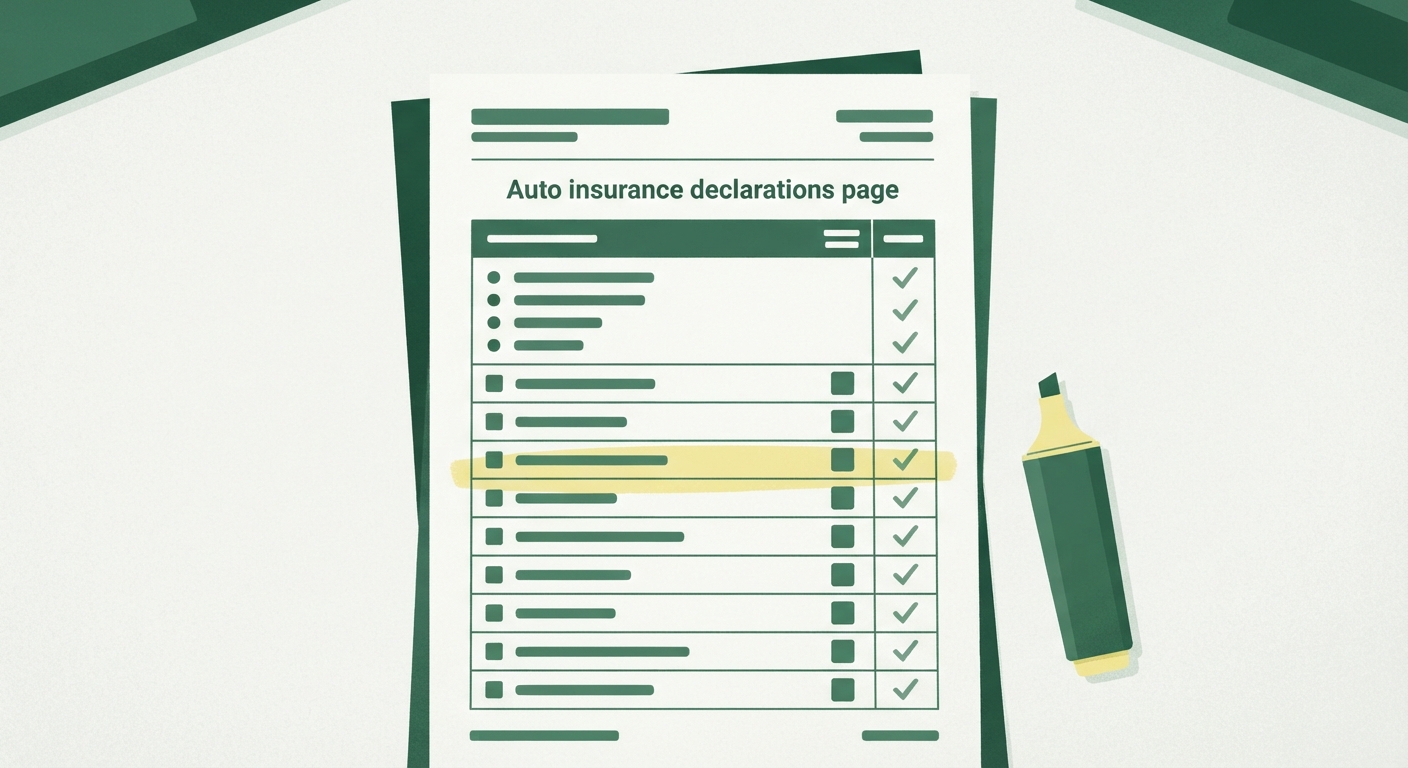
Find Your Declarations Page in Five Seconds
Every auto policy has one page that summarizes the whole deal: who’s covered, what car, what limits, what you’re paying, and for how long. That’s the declarations page, usually just called the “dec page.” It’s the cover sheet of your policy packet, and it’s the only page you need to look at for this check.
If you have a paper packet, it’s the first or second page after the cover letter, often printed on different paper stock or with a header that says “Declarations” or “Policy Declarations.” If you’re digital, log into your insurer’s app or website, go to your policy, and look for a button labeled “Declarations,” “ID Cards & Documents,” or “Policy Documents.” Most insurers let you download it as a PDF in under a minute. If you genuinely can’t find it, call the number on your insurance card and ask them to email or text you a copy — this is a routine request and takes them seconds.
Once you have it in front of you, you’re looking at four blocks of information: named insured and address, vehicles, drivers, and coverages with limits and deductibles. That’s the whole check. Set a timer for five minutes and go block by block.
Confirm Vehicle Details, VIN, and Garaging Address
Start here because errors in this section are both common and consequential. Your policy is written around a specific vehicle at a specific address, and if either is wrong, it can complicate a claim later.
- Year, make, model, and trim. Skim the description against your actual car. Typos happen during data entry, especially with trim levels or body styles, and a wrong trim can occasionally affect valuation if the car is ever totaled.
- VIN. This is the one item worth actually verifying character by character, not skimming. Pull the VIN off your registration or the sticker inside the driver’s door jamb and compare it to the dec page. A single transposed digit means the policy is technically describing a different vehicle. This is rare, but it’s exactly the kind of thing that’s cheap to catch now and annoying to catch during a claim.
- Garaging address. This is where the car is normally kept overnight, and it’s not always the same as your mailing address. If you moved, if a kid took the car to college, or if you’re storing a vehicle at a second property for part of the year, the garaging address on file should reflect that. Insurers use this address to help set your rate and to route certain claims correctly, so an address that’s a year out of date isn’t just paperwork — it may not match how the vehicle is actually used.
- Vehicle use. Check that the listed use — commute, pleasure, business — still matches reality. If you changed jobs and now drive twice as far to work, or if you started using the car for any kind of delivery or rideshare work, the “use” category on file may no longer fit. This is worth a call to your agent rather than a silent correction, since it can affect coverage.
If you own more than one vehicle on the policy, do this same three-item check (description, VIN, garaging address) for each one. It adds maybe a minute per car.
Check Listed Drivers and Any Household Changes
Next section: the list of drivers. This is where “life happened and I forgot to call” tends to show up.
Common changes worth checking for:
- A teenager who started driving. Most insurers want any licensed driver in the household added to the policy, even if they mostly drive their own separate car or don’t have their own car yet. If someone in your house got a license since the last renewal and isn’t listed, that’s the single most important gap to close before you renew.
- A driver who moved out. An adult child who moved to their own apartment, a former roommate, an ex-spouse — if they’re still listed as a household driver but no longer live with you or drive your vehicles, ask about removing them. This can also affect your rate, though don’t assume it will move in a particular direction; ask rather than guess.
- A driver who no longer drives. Elderly parents who surrendered a license, or anyone who stopped driving for health or other reasons, may still be sitting on the dec page from a prior year.
- Excluded drivers. Some policies list a driver as specifically excluded, meaning that person is not covered at all when driving your car. Confirm this is still what you intend. If a relationship changed since that exclusion was added, it’s worth revisiting rather than letting it roll over automatically.
- Marital status. If you got married, divorced, or entered a domestic partnership recognized by your state since the last renewal, tell your agent even if you don’t think it changes anything. It sometimes affects rating, and it always affects who’s assumed to be part of the household.
Go down the driver list by name and ask yourself: does everyone who currently drives this car regularly appear here, and does everyone who appears here still belong? Two minutes, tops.
Verify Coverage Limits and Deductibles Match What You Chose
This is the section where “what I meant to buy” and “what’s actually on the policy” sometimes drift apart, usually because of a renewal change that got mailed or emailed and never opened.
Look for these line items and confirm each one is where you expect it:
- Liability limits (bodily injury and property damage). These are usually shown as numbers like 100/300/100, meaning per-person, per-accident, and property damage figures. Confirm these match the level you actually selected, not just some number that sounds reasonable. If you increased your limits last year after a life change — new house, new assets, more driving — check that the increase actually took effect and didn’t get dropped at a subsequent renewal.
- Collision and comprehensive deductibles. These are the amounts you pay out of pocket before coverage kicks in for damage to your own car. Confirm the deductible listed is the one you intended, and note that many people carry a different deductible for comprehensive (glass, weather, theft) than for collision. If you asked to raise or lower a deductible at some point to adjust your premium, verify that change is reflected and didn’t quietly revert.
- Uninsured/underinsured motorist coverage. Check that this coverage is present at the limit you intended, if you carry it. This is coverage for when the other driver’s insurance is inadequate or nonexistent, and it’s easy to overlook because it doesn’t come up until you need it.
- Roadside assistance and rental reimbursement. These are optional add-ons on many policies. If you’re paying for one, confirm it’s actually listed. If you don’t have one and thought you did, that’s worth catching before you need a tow.
- Any endorsements or riders for things like custom equipment, rideshare use, or a named additional vehicle. If you added anything like this, it should appear as a separate line, not buried in a note.
A practical way to check limits and deductibles quickly: keep last year’s dec page (or a screenshot of it) and put the two side by side. Anything that changed should be a change you asked for or were told about, not a surprise. Insurers do occasionally adjust default terms at renewal, and the adjustment is usually disclosed in a renewal letter you may have skimmed past.
Two Things Worth Double-Checking While You’re In There
Since you already have the document open, two quick extras take almost no additional time.
Policy period dates. Confirm the effective and expiration dates line up with when you think your policy renews. This matters if you’re timing a comparison shop, a vehicle sale, or a move, since acting a few days off from the actual renewal date can create a coverage gap or a double-payment.
Named insured spelling and address. A misspelled name or an old mailing address won’t usually block a claim, but it can slow down correspondence, delay a refund check, or cause a renewal notice to go to the wrong place. Fix it now while it’s a two-minute phone call instead of a problem during a claim.
What to Do With What You Find
If everything matches, you’re done — file the dec page somewhere you can find it again, ideally alongside your insurance card, and move on with your renewal.
If you find a mismatch, sort it into one of two buckets before you call your agent:
- Factual corrections — a wrong VIN character, a misspelled name, an old address. These are usually quick fixes with no rate impact, and most insurers can correct them same-day.
- Substantive changes — a driver who needs to be added or removed, a garaging address that changed because you moved, a coverage limit you want adjusted. These may affect your premium, so ask directly what the change will do to your rate before you confirm it, rather than assuming.
Either way, get the correction in writing — a confirmation email or an updated dec page — so you have a record that matches what you were told on the phone. That’s the whole exercise: five minutes of reading, a couple of phone calls if something needs fixing, and a policy that actually reflects the car you drive, the people who drive it, and the coverage you meant to buy.
